

How the Coronado Community Foundation Explored AI for Augmenting Its Strategic Planning and Operations Processes
Every organization measures aspects bearing on its performance. The real question is whether it is measuring the right things and using the data obtained to better assess situations, identify challenges and opportunities and, hopefully, find ways to improve performance and (perhaps, even, its core processes).
For nonprofits, this challenge can be especially difficult. Unlike businesses, whose success can often be summarized through revenue and profit, community foundations pursue missions that combine financial stewardship, community impact, volunteer engagement, donor relationships, and long-term social outcomes. Traditional nonprofit metrics provide a useful starting point, but they may not fully capture what makes a particular organization successful.
This article describes an experiment in using AI to assist in exploring, identifying, evaluating and utilizing Metrics and Key Performance Indicators (KPIs) as performance measures and processing agents for the Coronado Community Foundation[1] (CCF). Rather than replacing established nonprofit (NP) benchmarks, artificial intelligence was (and continues to be) used as a research and brainstorming partner to explore which metrics might be most relevant for a local community foundation and how those metrics/KPIs could support better operational and strategic decision-making processes.
The project illustrates a broader lesson: AI can help organizations move beyond simply tracking performance and toward discovering new ways to improve it.
Why Metrics/KPIs Matter for Nonprofits
Nonprofit organizations are unique in their missions, governance structures, funding sources, and regulatory environments. Yet they share something important with every successful business: they must make decisions under uncertainty.
Strategic planning and day-to-day operations both depend on information. Leaders need to know:
- Which activities create the greatest impact in terms of data gathering and decision-making?
- Which programs deserve additional resources (or perhaps be augmented, created or phased out)?
- Which fundraising efforts are most effective?
- Where are emerging risks appearing?
- Which opportunities are being missed?
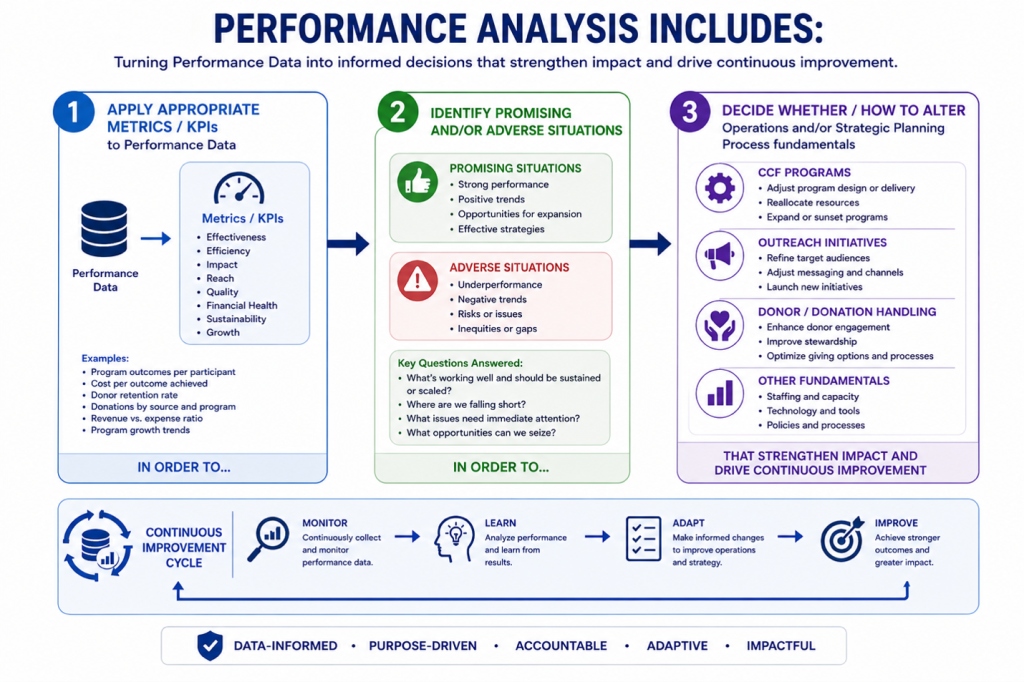
Metrics and Key Performance Indicators (KPIs) help answer these questions by transforming raw data into actionable information and procedures. Many nonprofits already use benchmark metrics provided by organizations such as the nonprofit database maintained by Candid (formerly GuideStar[2]) and the evaluator Charity Navigator[3]. These benchmarks help organizations compare themselves against peers and identify areas for improvement.
However, benchmarks are only the beginning.
Why Use AI Instead of Relying Only on Standard Metrics/KPIs?
Traditional metrics/KPIs answer questions that someone has already decided are important.
AI can help identify questions that may never have been considered and help in identifying what might be improved and how that might be accomplished.
For example, most NPs track donor retention rates. But AI can suggest exploring deeper questions such as:
- Which types of donors are most likely to become and remain long-term supporters?
- Which communication patterns correlate with increased giving?
- Which programs attract new donors versus retaining existing donors?
- Which indicators predict future fundraising success before it becomes visible in annual results?
These are examples of what might be called AI-derived metrics/KPIs—measures suggested through AI-assisted analysis, decision-making and processing rather than inherited from standard NP scorecards.
The value is not that AI magically discovers hidden truths. Rather, AI can rapidly synthesize ideas from thousands of examples, research papers, nonprofit practices, and management frameworks, helping organizations generate better hypotheses for what should be measured and acted upon.
In this project, AI was (and continues to be) used primarily as an idea-generation and research tool for human-in-the-loop processing, rather than as an autonomous decision-making agent.
How AI Was Used
The project used several large language models (LLMs) to assist with several tasks:
- Researching metrics/KPIs for nonprofit organization (NPOs), both benchmarks and actual organizations.
- Mapping those metrics/KPIs to CCF’s mission and activities.
- Suggesting additional metrics/KPIs that might be especially relevant to a community foundation.
- Exploring relationships among fundraising, outreach, program effectiveness, and donor engagement.
- Identifying potential leading indicators that could predict future outcomes.
- Dynamically informing decisions pertaining to potential improvements to data collection, programs and (operations and strategic planning) processes.
A simplified example of the prompt used during the project was:
Coronado Community Foundation is a local community foundation that supports nonprofit service providers through grants, fundraising, community outreach, and strategic guidance. Identify operations and strategic planning metrics/KPIs that could help leadership evaluate organizational performance, fundraising effectiveness, community impact, donor engagement, and long-term sustainability. Include both conventional nonprofit KPIs and potentially novel metrics that might provide additional insight.
The resulting suggestions were then reviewed by humans and filtered based on relevance, practicality, and data availability.
This human-in-the-loop process is critical. AI generates possibilities; people decide which ideas deserve implementation.
A Framework for AI-Enhanced Metrics/KPs
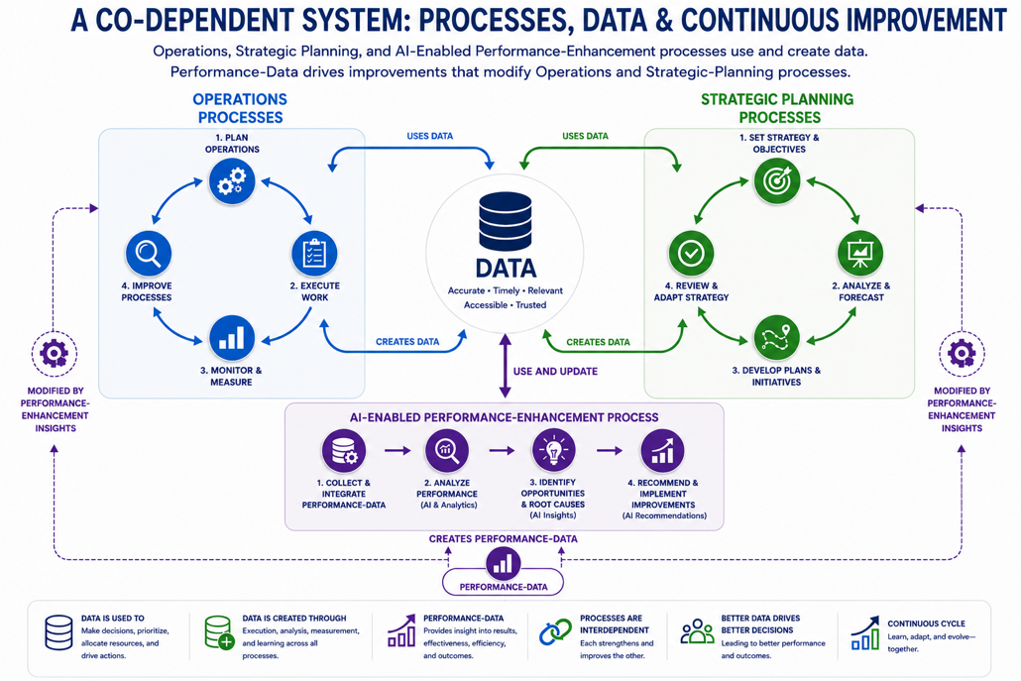
One useful insight from the exercise was that strategic planning, operations, and data form a continuous feedback loop.
- Data informs metrics/KPIs.
- Metrics produce scores and evaluations.
- Evaluations support decisions.
- Decisions drive actions.
- Actions generate new data and can/should be used to modify/improve operations and strategic planning processes themselves, which of course are data-driven.
AI can potentially strengthen every step of this cycle by helping leaders identify (and operationalize) patterns, trends, risks, and opportunities that might otherwise remain unnoticed/missed.
Rather than viewing metrics/KPIs as static reports, NPOs can begin to think of them as components of an adaptive learning system.
Metrics/KPIs Relevant to the Coronado Community Foundation
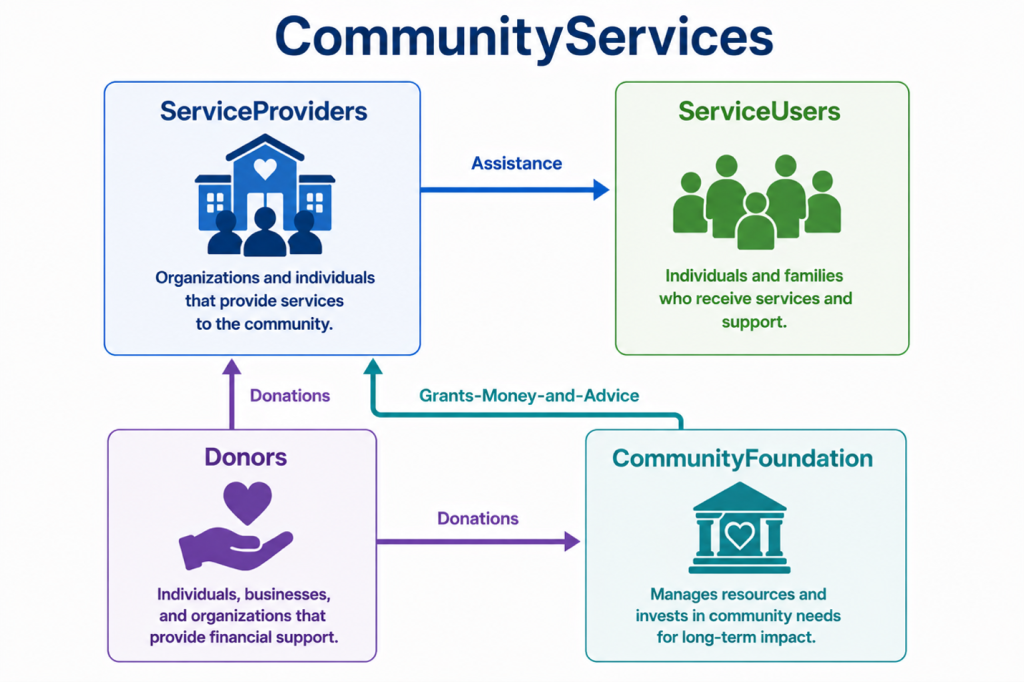
Several categories emerged as especially important for CCF.
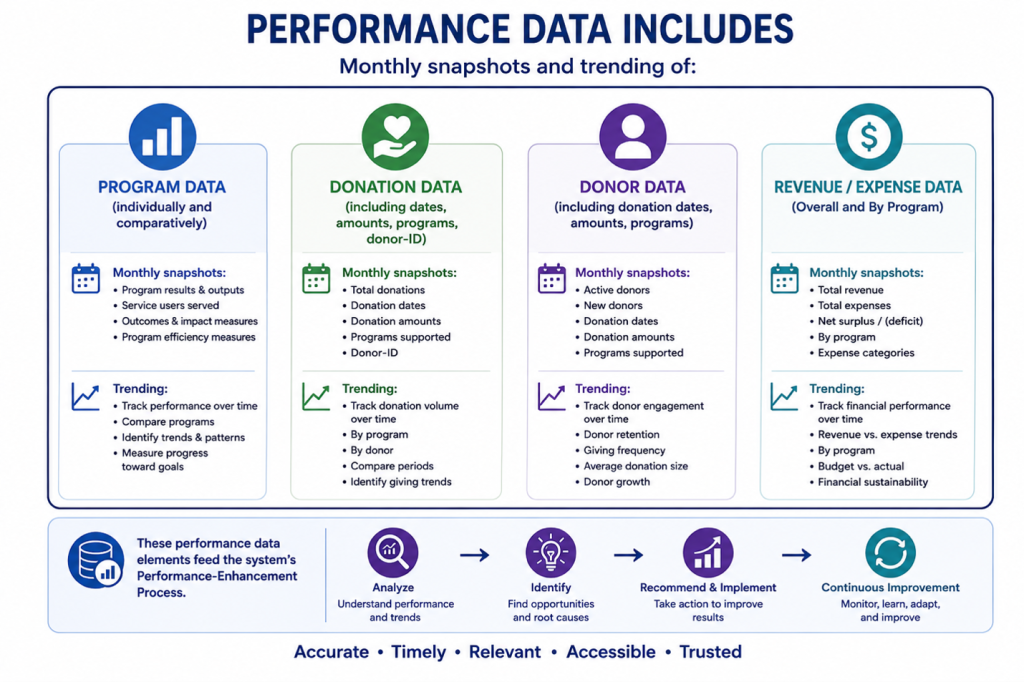
Donors and Fundraising
Fundraising remains central to the CCF’s ability to support local programs.
Important measures include:
- Donor retention rate
- New donor acquisition rate
- Average gift size
- Donor lifetime value (i.e., total donations by donors)
- Repeat donation frequency
- Fundraising return on investment
- Donor engagement by various communication methods (e.g., outreach, website)
AI also suggested examining donor behavior patterns over time (e.g., monthly, quarterly, seasonal) rather than relying solely on annual totals.
Programs and Community Impact
CCF Programs support a variety of community priorities, including:
- Health and wellness
- Arts and culture
- Neighbors in need
- Community heritage
- Organizational capacity building
Potential metrics/KPIs include:
- Dollars donated (and expenses incurred) by program area
- Number of beneficiaries served
- Grant renewal rates
- Community participation levels
- Outcome achievement rates
- Stakeholder satisfaction
Some of these measures are quantitative, while others require surveys and qualitative feedback.
Financial Stewardship
Financial metrics/KPIs remain essential for demonstrating responsible management.
Examples include:
- Revenue growth
- Expense trends
- Net operating surplus
- Administrative cost ratio
- Program efficiency ratio
- Reserve adequacy
These metrics/KPIs help ensure that resources are being deployed effectively in support of mission objectives.
Community Outreach and Visibility
For a community foundation, visibility often translates directly into donor engagement and program participation/improvement.
Useful measures include:
- Website traffic
- Newsletter open rates
- Outreach click-through rates
- Social media engagement
- Event attendance
- Volunteer participation
AI suggests that changes in engagement metrics/KPIs may serve as early indicators of future fundraising performance.
Beyond Traditional Metrics/KPIs
Perhaps the most interesting outcome of the exercise was the identification of several possible metrics that are not commonly found in nonprofit dashboards.
Examples include:
· Community Awareness Index
A composite measure combining website activity, event attendance, survey responses, and social media engagement.
· Donor Engagement Depth Score
A measure incorporating attendance, volunteer activity, communications engagement, and donation behavior.
· Grant Leverage Ratio
An estimate of how much additional funding or community impact is generated by grants supported through CCF.
· Program Portfolio Balance
A set of metrics/KPIs evaluating whether resources remain aligned with strategic (and operational) priorities across multiple community needs.
These examples are still conceptual, evolving. They would require validation and refinement before operational use. Nevertheless, they illustrate how AI can encourage organizations to think beyond standard reporting frameworks.
Potential Role of Core Processes & Performance Data/Analysis/Control
Limitations and Cautions
AI-generated recommendations should not be accepted automatically.
Large language models can generate plausible-sounding ideas that are impractical, unsupported by data, or whose consistently is difficult to measure.
Any proposed metric/KPI should be evaluated against several criteria, including:
- Does it align with organizational goals?
- Can it be measured reliably?
- Will leadership actually employ the metric/KPI?
- Does it influence decision-making?
- How might including this metric/KPI impact other metrics/KPIs?
- Is the data available at reasonable cost?
Metrics/KPIs should clarify reality, not create unnecessary complexity.
Looking Ahead
The nonprofit sector has always depended on thoughtful stewardship of limited resources. AI will not replace leadership judgment, organizational knowledge, or community relationships. However, it can become a valuable partner in discovering better questions, identifying (and adapting) meaningful metrics/KPIs, and exploring new ways to improve organizational performance.
For the Coronado Community Foundation, this project, which is still in an early stage, has demonstrated that AI is not merely a tool for writing text or generating images. It can also help organizations rethink how they measure, evaluate and respond to success/challenges.
The most promising opportunity may not be using AI to report on what has already occurred, but rather to employ AI-derived performance enhancement techniques in combination with metrics/KPIs to better understand and operate proactively in the future.
[1] Coronado Community Foundation (https://www.ccfcoronado.org/)
[2] GuideStar (https://www.guidestar.org/)
[3] Charity Navigator (https://www.charitynavigator.org/)
Leave a Reply