
Large language models have become very good at writing. So much so, that it can be difficult to tell if something has been written by a human or an AI. But, whereas humans can be fooled, it seems deep-learning algorithms cannot. Especially one called Pangram.
As good as AI-writing can be, the majority of readers, especially if they are paying for the privilege, want material written by humans. The derisive term ‘AI Slop’, clearly conveys the low regard in which AI-written articles are held. People can get very annoyed if what they thought was written by another person was in fact written by a machine.
Opinion columnist plea
I recently read an opinion piece by Bret Stephens in the New York Times, urging people to do their writing themselves, and not rely on an LLM to do it for them. Here’s his rationale:
The problem with writing with A.I. is that it’s mentally enfeebling — an escalator toward a result when you really need to make a daily habit of taking the stairs. As it becomes ubiquitous, it undermines not only our individual ability to write but also a society’s collective ability to reason, a culture’s inner capacity to create and everyone’s reason to care.
I think he is right to be concerned. Organizing your thoughts before putting pen to paper, then selecting the right turn of phrase to communicate those thoughts, is a superb cognitive work out. I can feel my brain humming as I (not Claude) write this post
Nevertheless, AI-written text is on the increase — in the academic realm, in school, in business, and, it appears, on the pages of the Reddit newsletter platform. AI slop seems to be taking over the writing world.
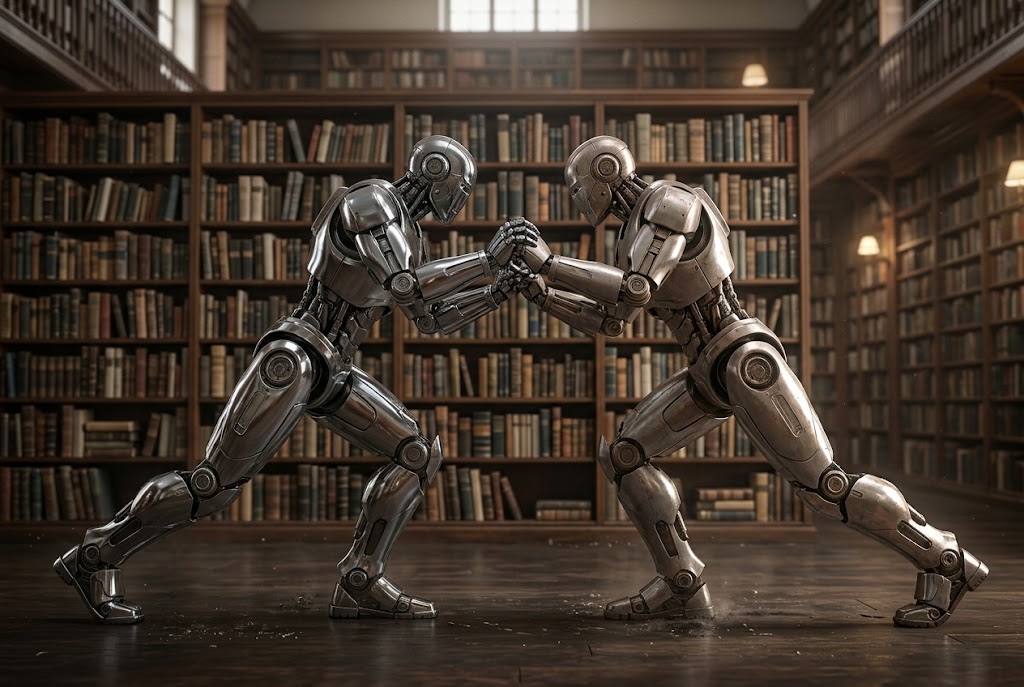
But, never fear: just as Sir Isaac Newton explained in his third law of motion, for every action, there is an equal and opposite reaction.
AI-writing detective
Enterprising technologists in Silicon Valley have built AI-writing detectors, to root out this literary scourge. And the one that’s making headlines, with claims of 99+% success rate, is Pangram. In fact, the Reddit newsletter platform mentioned above, has now integrated Pangram into its system. Readers can press a Pangram button, which will tell them the extent to which a piece of writing was generated by a human or an AI.
Pangram employs a deep-learning algorithm, trained on vast troves of human- and AI-writing. It has learned to spot characteristic tics and quirks common to AI-generated text. Readers who have followed this field will know that excessive use of em-dashes — those very useful grammatical flourishes that help isolate a relevant piece of information — has long been a characteristic of AI-writing.
Did you see how I snuck in that pair to exemplify their use?
My trials
As someone who enjoys writing, I find this whole business fascinating. I also wondered whether Pangram is as good as it claims. So, I ran a trial of my own, using free credits on the web-version. I pasted in two examples of writing on the same topic. It’s related to weather-sealing on cameras. Here is the first one:
Camera weather sealing: who actually proves it?
Most cameras claim to be weather-sealed. Only a handful of manufacturers back that claim with a tested rating.
“Weather-sealed” is one of the most common phrases on a modern camera spec sheet. It appears on bodies from Canon, Nikon, Sony, Fujifilm, Panasonic, Pentax, and Leica’s own M-System, among others. Very few of those claims are backed by an independent test.
Only Leica and OM System currently publish a certified IP rating for their mainstream cameras, alongside a handful of rugged compacts built for exactly this purpose. Everyone else relies on descriptive language: “weather-sealed”, “dust and moisture resistant”, “built to withstand the elements” and similar phrasing. This piece sets out what those IP numbers actually mean, ranks the market as of August 2026, and looks at Leica’s own hierarchy in more detail.
Here is the second example
Weatherproof, or just weather-talk?
I don’t shoot in the rain if I can help it — but that didn’t stop me from digging into which cameras can actually prove they’d survive it.
I am, by both temperament and upbringing, a fair-weather photographer. Rain sends me indoors for a cup of tea rather than out with a camera, and I’ve never once had cause to test whether my M11 would survive a downpour, because I’ve never let it near one. That admission matters here, because this isn’t a hands-on trial by rainstorm — it’s a look at what camera makers actually claim about weatherproofing, and, more usefully, which ones can prove it.
Spend five minutes on any manufacturer’s website and you’ll find the word “weather-sealed” attached to almost every camera above entry level. It sounds reassuring. It also, in the vast majority of cases, means precisely nothing you could hold anyone to.
Only two manufacturers currently put a tested number behind the claim: an IP rating, the same kind of code stamped on smartphones and power tools. Everyone else, from Canon to Panasonic, prefers the comfort of adjectives.
Decision time
So, which of these excerpts was written by AI? The first takes a rather formal, somewhat authoritative approach. The second is a more personal, verging on jocular approach to what is a fairly dry subject (sorry about that!).
If you identified the first as AI-writing, well done — you are correct. If you identified the second as AI-writing, well done — you are correct!
So, both were written by Claude, with slightly different guidance on the style to be adopted.
How did Pangram do? It correctly identified both as 100% AI-writing.
I am very impressed. As a final check, I submitted the opening section of this article to Pangram. It correctly categorized it as 100% human-writing.
What comes next?
Because of concerns about rapidly expanding use of LLMs to write all manner of material, without disclosing that it was not written by a human, further measures are being introduced to protect consumers. For example, Anthropic, in order to comply with requirements in the EU, is introducing a ‘watermark’ into all Claude-written text.
The details of this watermarking procedure have not been shared, but many commentators believe it will be integrated into the text itself. For example, rather than selecting the highest probability token next in a sentence, Claude will select a lower probability token. The resulting sentence will make sense, and be grammatically correct, but will signal to the relevant detection system that it was written by Claude, not a human.
Would the widespread introduction of watermarking approaches such as this render Pangram and other AI-writing detectors obsolete? That remains to be seen, but for now, if you suspect something you have read recently might have been written by AI, I would recommend you plug it into Pangram and check it out. Based upon my experience, the truth will out!
Are you concerned about the proliferation of AI-writing? Do you use an LLM to do your writing for you? Let us know in the comment section below.
Leave a Reply