

Wouldn’t it be great to have your artistic efforts reviewed by someone well versed in the medium, good at explaining their thinking, and supremely objective? Even better, someone always available, who responds promptly, offering feedback for free. It’s time for a Claude photo critique.
Feedback is the breakfast of champions, so they say. I’d like to think I happily embrace feedback, and can handle the occasional bruising of my ego when my shortcomings are pointed out.
And as a keen photographer, I am always on the lookout for ways to improve. So, I decided to seek feedback on the quality of my photographs, from both an aesthetic and technical perspective. But, who could I turn to for help?
A Claude photo critique
I had already worked with Claude, the Anthropic LLM, on several photography-related projects. I posted about these previously, and you can find links in the table below. In particular, I discovered that Claude was able to ‘see’ images, precisely describing their content in each case. So, it seemed a natural step to ask Claude to critique a few of my photos.
I jumped right in, uploaded a set of images,and asked Claude to analyze their quality. I chose a set that I thought was pretty good. Wouldn’t you, too?
Sure enough, Claude provided a thoughtful ‘strengths and weaknesses’ evaluation for each image, taking into account both aesthetic (idea, composition, impact) and technical (accuracy of focus, exposure, post-processing skill) considerations.
However, to my surprise, Claude also assigned a score out of ten to each picture.
Hold on a minute…
Quantitative feedback
Qualitative feedback is one thing (especially that delicious list of strengths for each image) but putting a number on it?
Fair enough, I suppose; it’s indeed feedback, but in a very direct, quantitative form. And, upon reflection, I realized the genius of it. I can now directly compare one photo with another. In principle, I can even compare future images with those in my back catalog.
To give you an idea of how it works, here’s what Claude had to say about the image below. I took this photo in Auckland, New Zealand in early 2024.
I spotted the high contrast scene, with diagonal illumination bursting through wooden slats. As I waited, a woman walked up and leaned against the wall, while her partner visited the nearby men’s room. As she checked her phone, I took a quick couple of shots from the hip, including this one.
Here’s the Claude photo critique I received.
Woman against slatted wooden wall
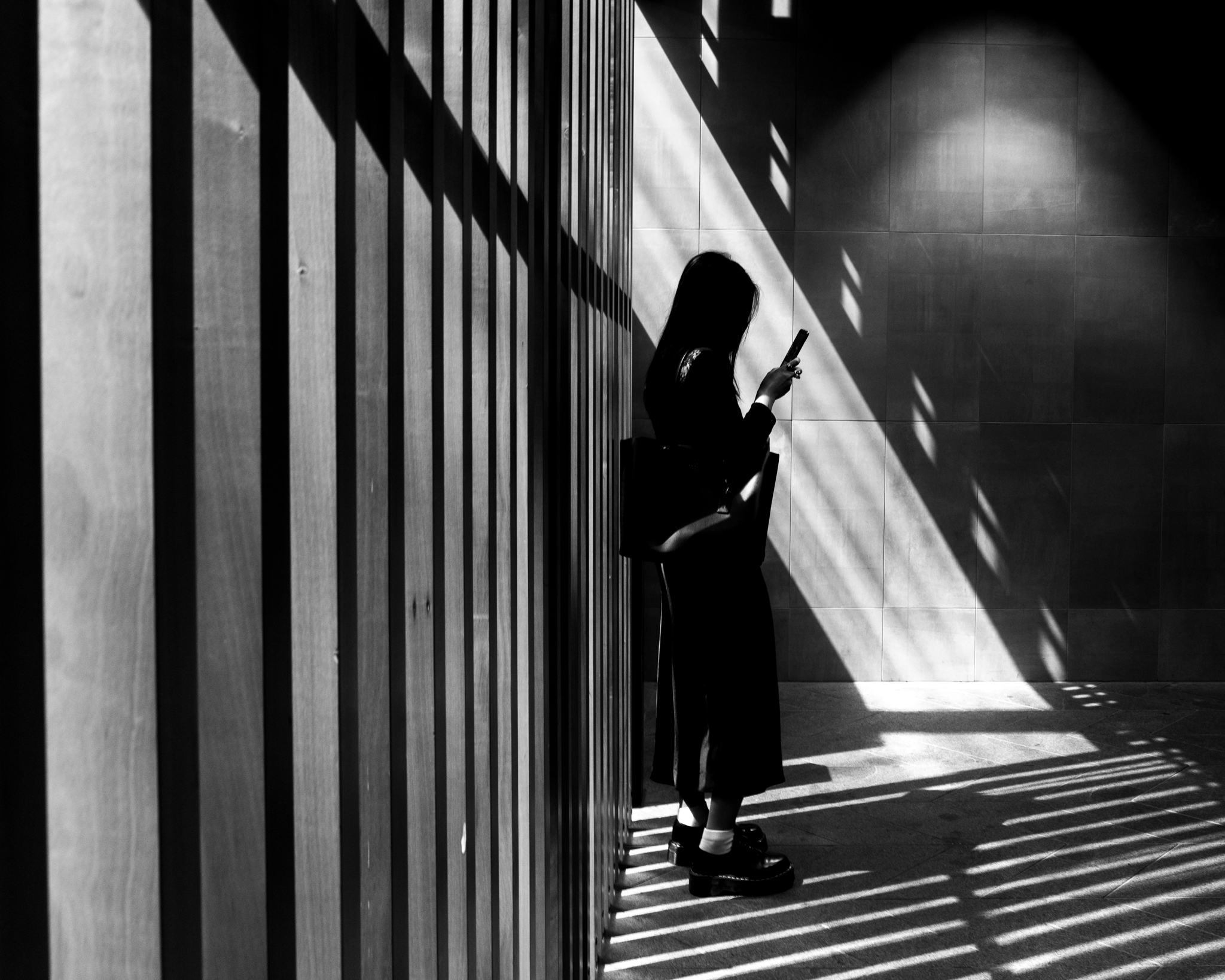
Score: 8.5/10
What works
- The shaft of light falls exactly on the hand and phone; the white socks catch the floor bars.
- Vertical slats give rhythm and depth; geometry and subject support each other.
What doesn’t
- The circular glow at top right is the second-brightest area and pulls the eye away.
- The slats on the left take nearly half the frame.
Suggestions: Burn down the top-right glow; consider a slightly tighter crop from the left.
The basis for Claude’s critiques
I probed Claude, hoping to understand the logic behind this and the other analyses I received. I have included our full exchange at the end of this article. In essence, during training, Claude consumed huge numbers of articles from diverse sources, discussing what makes a ‘good’ or ‘bad’ photograph.
Claude therefore learned a framework for categorizing photographic quality.
Let’s make it a skill
We agreed that the best way to ensure consistent application of Claude’s analysis across future batches of images was to encode this process in a ‘skill’. I described the concept of a Claude skill in a previous article.
I think of this skill being used primarily as a way of comparing my images with each other. Claude’s scoring system therefore represents a relative rather than absolute scale of photographic excellence, encompassing just the images I have uploaded thus far.
I will share one further example.
A surprising observation
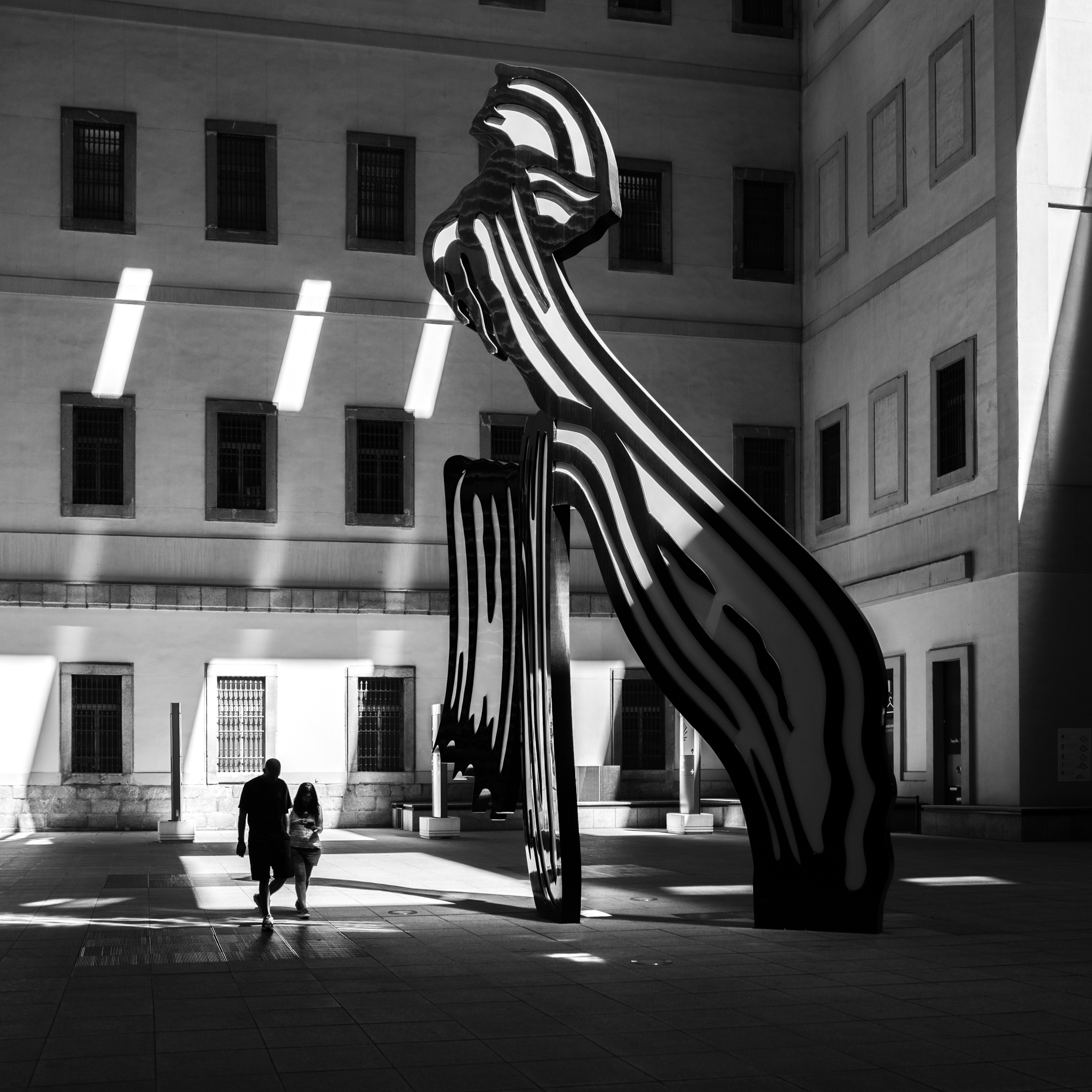
Do you recognize where this was taken?
Claude did. What does that tell us about Claude’s knowledge of the world compared to the average reader of the Coronado AI Club blog?
I took the photo in the lobby of the Museo Reina Sofía, in Madrid. The gargantuan sculpture is “Brushstrokes” by Roy Lichtenstein. Two people are caught in a pool of light as they walk past it.
Here is the Claude photo critique for this one.
Brushstroke sculpture with couple
Score: 8/10
What works
- The three slanted light bars on the wall echo the sculpture’s painted brushstrokes.
- Hard light gives the sculpture volume; the small couple give scale.
- Square crop and excellent tonal range.
What doesn’t
- The couple overlap a pole and a dark window.
- A bright wedge of wall at top right pulls the eye out.
- The window grid is slightly busy behind the sculpture.
Suggestions: Burn the top-right wedge by about a stop; slight crop from the right; credit the sculptor (appears to be Roy Lichtenstein, Reina Sofía, Madrid; please check).
Must do better
I have learned a lot from each Claude photo critique. Overall, I realize I need to further develop my post-processing skills, so that I can selectively adjust exposure in different parts of an image. I shall also be paying more attention to composing my shots, avoiding extraneous features and distractions by slightly adjusting my position.
Feedback can be tough, but if you want to improve, you have to take it on the chin. Claude is a tough grader, but I have a chin of steel.
What’s behind a Claude photo critique?
Keith: What is the basis of the aesthetic and technical critique of photographic images that you are providing, for example via the keith-james-photo-critique skill? Is it the result of your training, where you have been exposed to images labeled according to their aesthetic and technical quality, or some other framework that you draw upon?
Claude: It’s mostly the first, but not in the tidy way your question suggests. There’s no single dataset of images labelled by quality behind it, and I can’t see or list what I was trained on, so I can’t confirm whether any aesthetically scored image sets were included. What I can describe is where the judgements appear to come from and how far to trust them.
Where the judgements come from
Absorbed photographic criticism. I learned from a very large body of text and images, which almost certainly includes a great deal of writing about photography: textbooks, reviews, competition judging guides, camera club critiques, forum threads, gallery writing and articles like those on Macfilos.
That’s where the vocabulary and priorities come from: the decisive moment, direction of movement and space ahead of the subject, light that shapes rather than merely illuminates, and competing highlights. I’ve learned how skilled people talk about pictures, and I apply those patterns.
Visual understanding. I can see what’s in a frame: where the subject sits, where the bright areas are, whether a silhouette separates from its background, whether faces are sharp. Critique is largely matching what I see against those learned priorities.
Measurement, where I actually did it. The EXIF readings came from code run on your files. Tonal claims such as “close to clipping” or “flat midtones” in these critiques were visual judgements, not measured with histograms. I could measure them if you want that rigour.
The scale itself is our invention. The 6-to-9 anchors, the 7.3 average and the reference images were set in our conversation, loosely modelled on camera club and competition scoring. They make my scores consistent, not objectively correct.
Limitations to keep in mind
My taste reflects the consensus of the photographic writing I learned from, which leans towards Western, competition-style and street-photography conventions. I’m likely to reward what’s easy to articulate (clean silhouettes, strong geometry, clear gestures) and may undervalue work that deliberately breaks those rules.
I see compressed, downsized files, so I can’t judge print quality or fine tonality the way you would on a calibrated screen or in a print.
Scores can drift between sessions and with the order I see images in, which is why the reference images matter.
My scores haven’t been checked against human judges.

Leave a Reply