
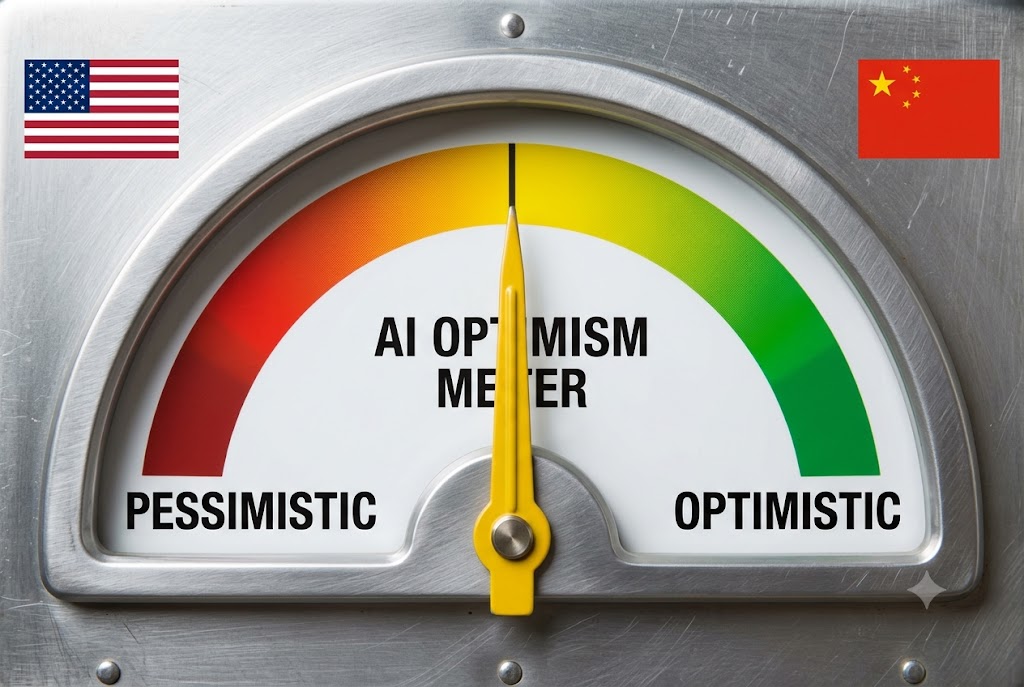
The answer to this question seems to depend on the country in which you live. Responses very widely across the globe. Where do you think the United States sits on an AI-optimism versus pessimism scale?
Rapid developments in artificial intelligence are permeating both the public’s consciousness and society’s discourse. The result is the emergence of an AI-optimism versus pessimism split.
What’s behind the AI-optimism versus pessimism split?
On one hand, resistance to building data centers, which are springing up all over the country, is growing. Texas has recently placed a moratorium on data center construction. Furthermore, concerns about AI-driven job-loss across many sectors of industry are growing. Freshly minted graduates know there will be few entry-level coding jobs available soon.
And, to cap it all, recent reports of powerful AI models escaping their constraints in order to hack into private company systems, are raising concerns about the risk of an autonomous AI-driven catastrophe.
On the other hand…
Advances in AI offer the prospect of addressing many of the challenges facing humanity, such as climate change, energy scarcity, and healthcare affordability.
Exciting new possibilities could be opened up by deployment of AI systems to operate physical objects, such as humanoid robots. As well as delivering a huge productivity boost, these advances could address the demographic issues of aging populations and insufficient care workers.
What’s does everyone think?
Integrating all these possibilities into a coherent view of future AI impact is challenging. Nevertheless, people are beginning to migrate to different points on the AI-optimism versus pessimism spectrum.
The Economist recently conducted a survey, asking over 23,000 people across 32 countries whether products or services that used AI made them nervous or excited. The results are shown in the screenshot below.
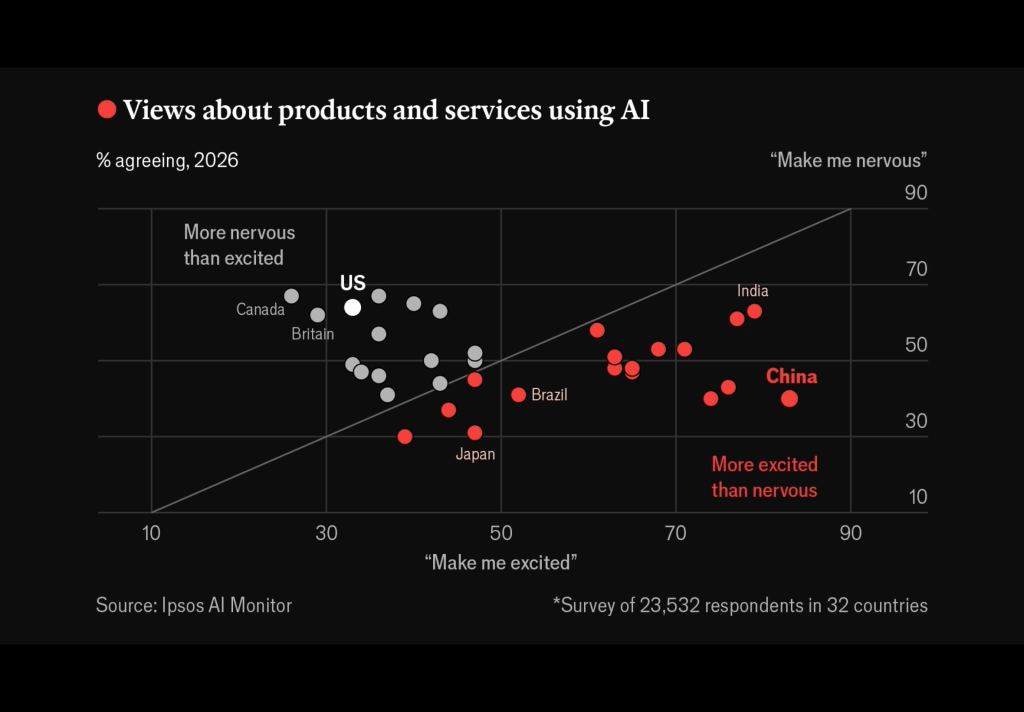
Its a two-dimensional plot of response, by country, along the two axes of ‘Make me nervous’ and ‘Make me excited’.
As you can see, people across the globe position themselves differently on the AI-optimism versus pessimism continuum. Strikingly, the US respondents were clearly more nervous than excited. That’s the opposite end of the spectrum to Chinese respondents. They were much more excited than nervous about these developments.
What’s going on?
It’s hard know why exactly Americans and Chinese feel so differently about the emerging impacts of AI.
Has a blizzard of negative media, or the doom-laden pronouncements of AI-company CEOs shaped the American view? Or, are Chinese people more open to technology, and dazzled by the humanoid robots they are seeing?
Apparently, the release of Chinese AI models, which are steadily closing the gap with American frontier models, is a source of pride within the country. Also, the Chinese government appears to be prioritizing the ‘diffusion’ of AI technology into every aspect of society.
So, perhaps more exposure to the technology makes people more comfortable with, and excited about, AI.
Why not share your perspectives in the comments below. It would be fascinating to hear where Coronado AI Club members land on the AI-optimism versus pessimism spectrum.
Leave a Reply